Institutional operating command

Know what requires attention today.

SquareCampus connects school operations, assigns ownership to exceptions, and gives leadership a governed view of what is changing across the institution.

Admin & trust command centre

SquareCampus command centre: attendance, fee collection, report publication and escalation figures across campuses, with an exceptions table listing each exception's campus, accountable owner, priority, status and next step

AEGIS governed intelligence

Explains what changed, who owns it, and what leadership should review next.

Illustrative product preview using synthetic data.

  • Exceptions surface with an owner — before term end.
  • Leadership sees current state, not stitched reports.
  • Every approval and override remains auditable.
  • Processes survive staff changes because ownership is recorded.

What institutions actually feel

The problem is rarely a missing feature. It is delayed visibility and unclear ownership.

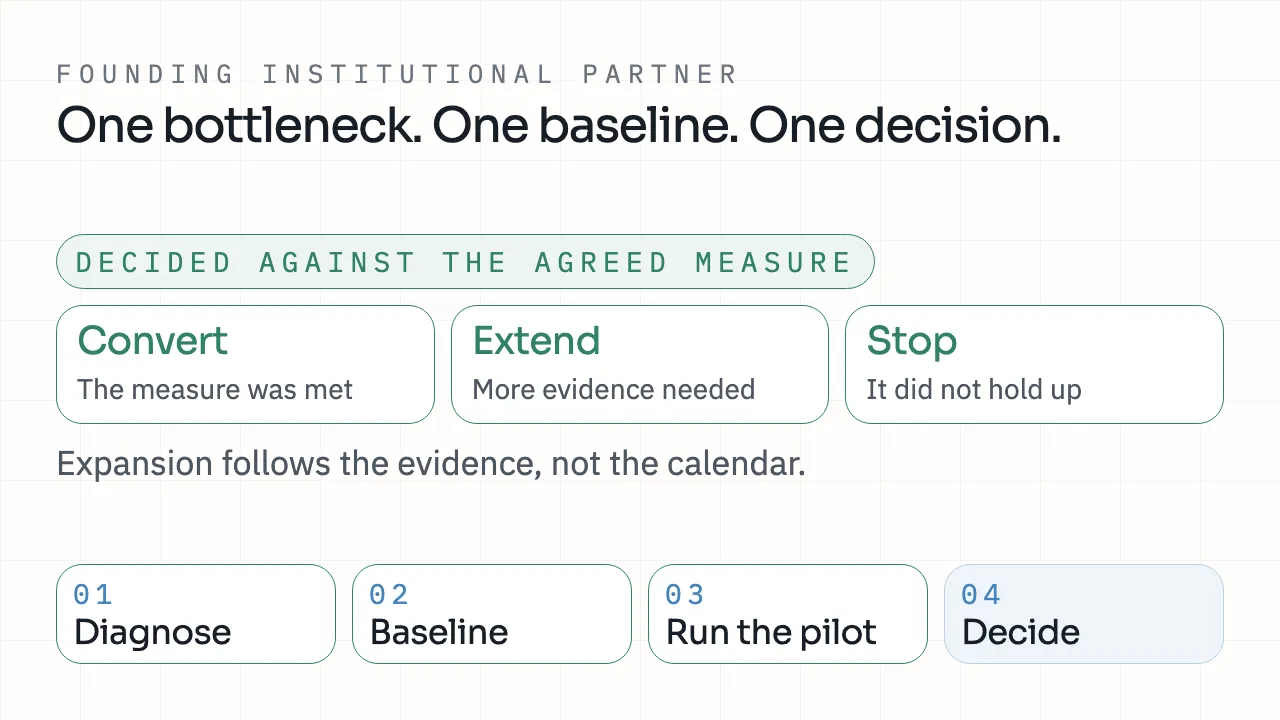
Recurring school cycles break in predictable places. Each one has a hidden cost, a remedy, an accountable owner, and something a pilot can measure.

Fee reconciliation

Collection records, bank statements and spreadsheets each hold part of the picture.

Finance spends the first week of every cycle rebuilding a number that should already exist.

One governed fee cycle carrying reconciliation state, ownership and escalation on the same record.

Accountable owner
Finance lead, with escalation to the trust office
Pilot measures
Time from collection close to a reconciled, signed-off position.

Attendance drift

Patterns are noticed once they have already become a term-level problem.

Intervention happens after the point where it would have changed the outcome for the student.

Threshold-based detection, routed ownership and follow-up recorded against the student record.

Accountable owner
Class teacher, escalating to the head of section
Pilot measures
Days between a threshold breach and a recorded follow-up.

Report-cycle delay

Compilation, correction, approval and publication collapse into the same fortnight.

Senior staff are pulled into chasing rather than reviewing, every single cycle.

Explicit stages, named owners, deadlines and exceptions that block publication.

Accountable owner
Examination officer, with principal approval
Pilot measures
Elapsed days across the full result cycle, and the number of blocked stages.

Decision latency

Leaders spend their time assembling context before they can decide anything.

The institution reacts at the speed of its reporting, not the speed of its problems.

Governed operational context with an explicit next-action layer behind it.

Accountable owner
Principal or trustee, depending on the decision
Pilot measures
Time from a signal appearing to a decision being recorded.

Record versus decision

A system of record stores what happened. A decision layer shows what requires attention, why it matters, who owns it, and what happens next.

SquareCampus helps school leadership know what requires attention today, who owns it, and what happens next.

The command centre

Management sees the institution the way a board expects to

The cost of fragmentation

Fragmented software taxes the institution every single day

Three connected journeys

Students, money, and decisions move through one system

Sovereignty

Your institution's data, under your institution's governance

Governed intelligence

AEGIS is the governed intelligence layer inside SquareCampus

Rollout & trust

Switching systems is an institutional decision. We treat it that way.

Next move

See whether SquareCampus can govern your institution.

Bring your current stack. We will map it against the governed operating model and walk through rollout, controls, and institutional fit — without reducing the conversation to a card wall of features.