
Platform architecture

One governed core. Many surfaces. No institutional drift.

SquareCampus is built like an operating system for institutions, not a loose bundle of modules. Admissions, academics, finance, communication, compliance, and day-to-day operations work off the same institutional truth.

Daily operations

Synthetic data
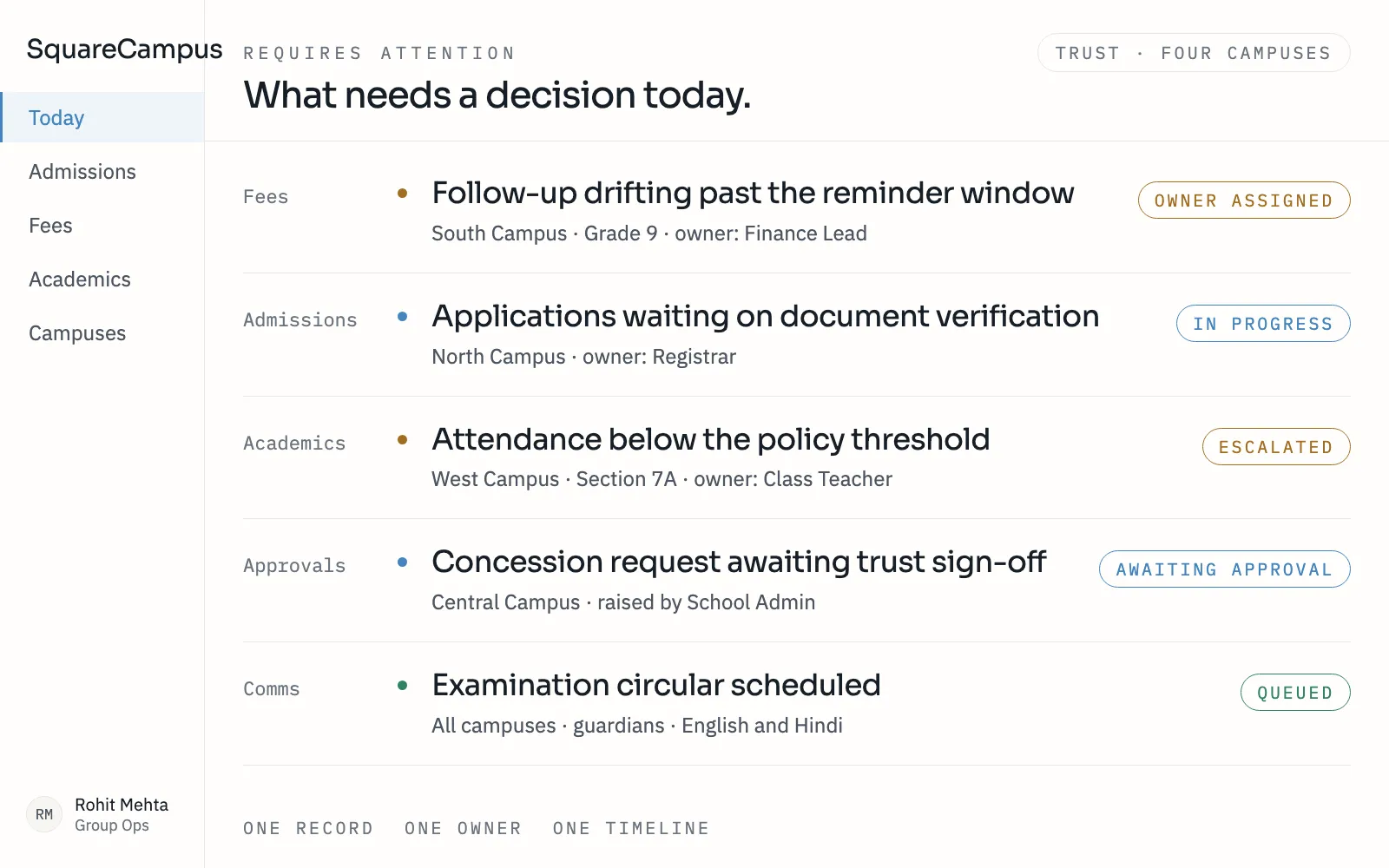
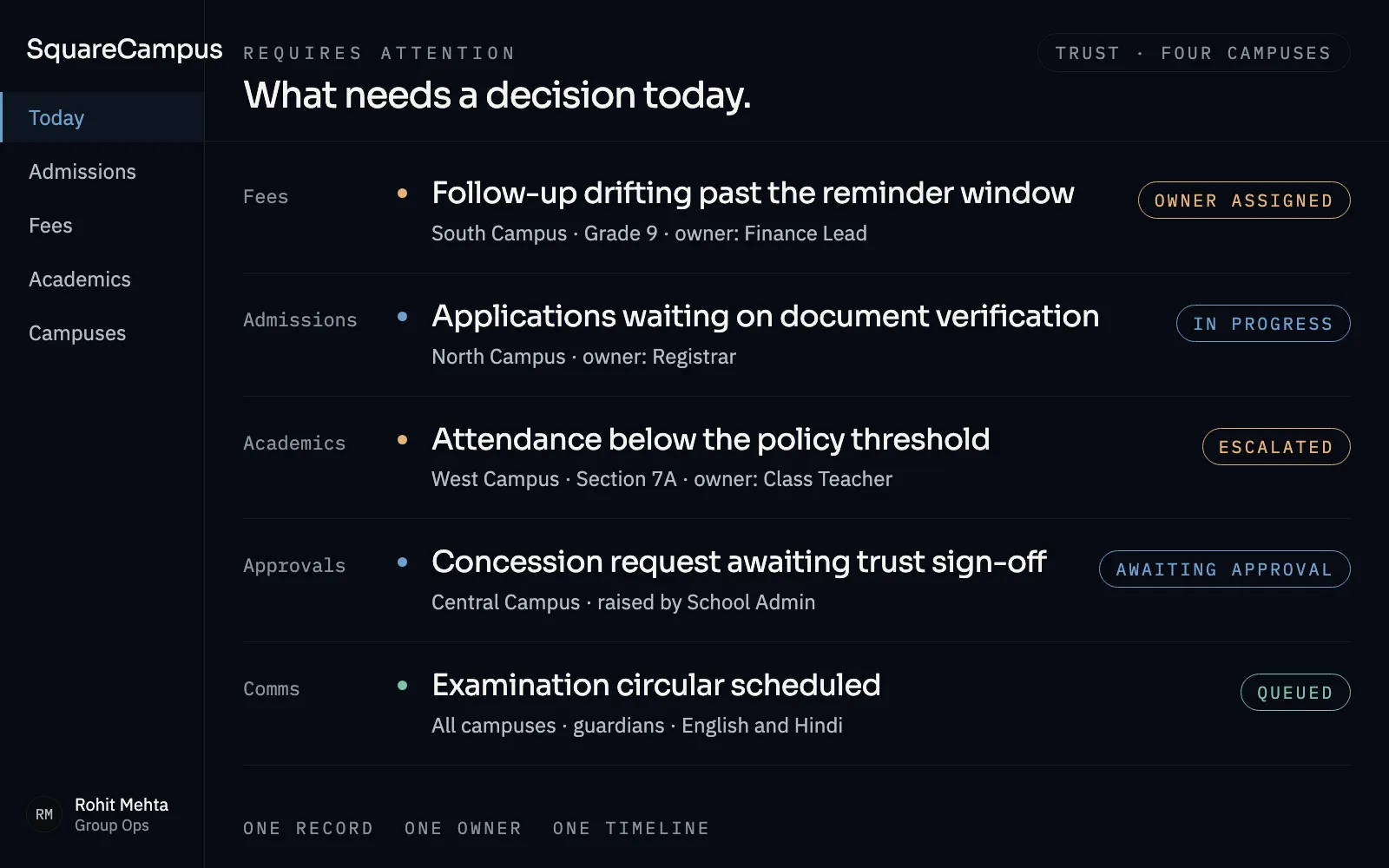
The SquareCampus daily operations console: fee follow-up drifting past its reminder window with an owner assigned, admissions waiting on document verification, attendance below the policy threshold escalated, and a concession request awaiting trust sign-off.
One login and one governed record for admissions, academics, finance, and communication.
Institution-aware structure for schools, colleges, and multi-campus organizations.
Multilingual parent-facing usage without turning English-first reporting into a mess.
AEGIS layered inside the platform as governed intelligence, not marketed as a substitute for operational depth.

How the School OS is structured

Four layers, each with an operational outcome

Every institutional workflow sits on the same foundation. What matters is not how many modules are present, but what each layer changes about the way the institution runs.

01

System of Record

One institutional truth.

Students, staff, fees, attendance, assessments and documents live on one model, so a question has one answer rather than one answer per tool.

What that includes

  • Student, staff and guardian records
  • Admissions and enrolment
  • Timetable, attendance and assessment
  • Fees, concessions and receipts
  • Documents and institutional history

02

System of Workflow

Work moves with an owner.

Admissions, collections, results, approvals and parent concerns run as workflows with stages, owners and deadlines — not as tasks held in someone's memory.

What that includes

  • Stages, owners and deadlines per cycle
  • Exception routing and escalation
  • Approvals and overrides
  • Parent and staff communication
  • Transport, hostel and campus operations

03

System of Governance

Every exception is accountable.

Policy, approval chains, role boundaries and audit history are institutional configuration, so exceptions escalate to a named desk and leave a trail.

What that includes

  • Role-based access and campus scope
  • Trust and campus hierarchy
  • Approval and governance chains
  • Audit history and advanced audit exports
  • Institutional identity: SquareCampus-managed sign-in, optional Microsoft Entra ID single sign-on from Pro, identity governance under Enterprise

04

System of Intelligence

Leadership sees what requires attention.

AEGIS reads the governed operational context and returns permission-scoped, source-grounded answers about what changed, why it matters and who owns the response.

What that includes

  • Operational analytics and command views
  • Threshold detection across cycles
  • Permission-scoped, source-grounded answers
  • Auditable question and answer history

Operating domains

The cycles the backbone has to carry

Evidence that the operating model is complete, rather than the reason to choose it.

Admissions to academics

From inquiry, documents, and enrollment through timetable, attendance, exams, and report publishing.

Finance to compliance

Fees, concessions, receipts, auditability, and institution-level oversight in the same operating model.

Communication as infrastructure

Parents, students, staff, and administrators receive the right information through the right channels without disconnected tools.

Operations as part of the core

Transport, services, assets, and campus workflows stay linked to the same institutional identity and timeline.

Shared core

The system underneath the UI matters

The real product advantage is not a prettier dashboard. It is that the institution stops operating through sync gaps, duplicate records, and broken reporting chains.

Admissions, academics, finance, communication and operations act on one identity, data and workflow core, so a change made once needs no export to reach the rest.

Shared identity

Users, permissions, and organizational boundaries are defined once and respected everywhere.

Shared data model

A record created in admissions becomes the same record used by academics, finance, and communication.

Shared operating timeline

Approvals, updates, dues, parent communication, and staff actions roll into one auditable sequence.

Shared observability

Leaders see the institution through live dashboards instead of stitched reports and spreadsheet exports.

Product surfaces

Designed for the people who actually run the institution

SquareCampus is not just an admin layer. Each audience gets a purpose-built surface, but the institution still runs on one connected operational model.

Admin command center

Branch health, role controls, rollout visibility, finance oversight, and policy enforcement from one place.

Teacher workspace

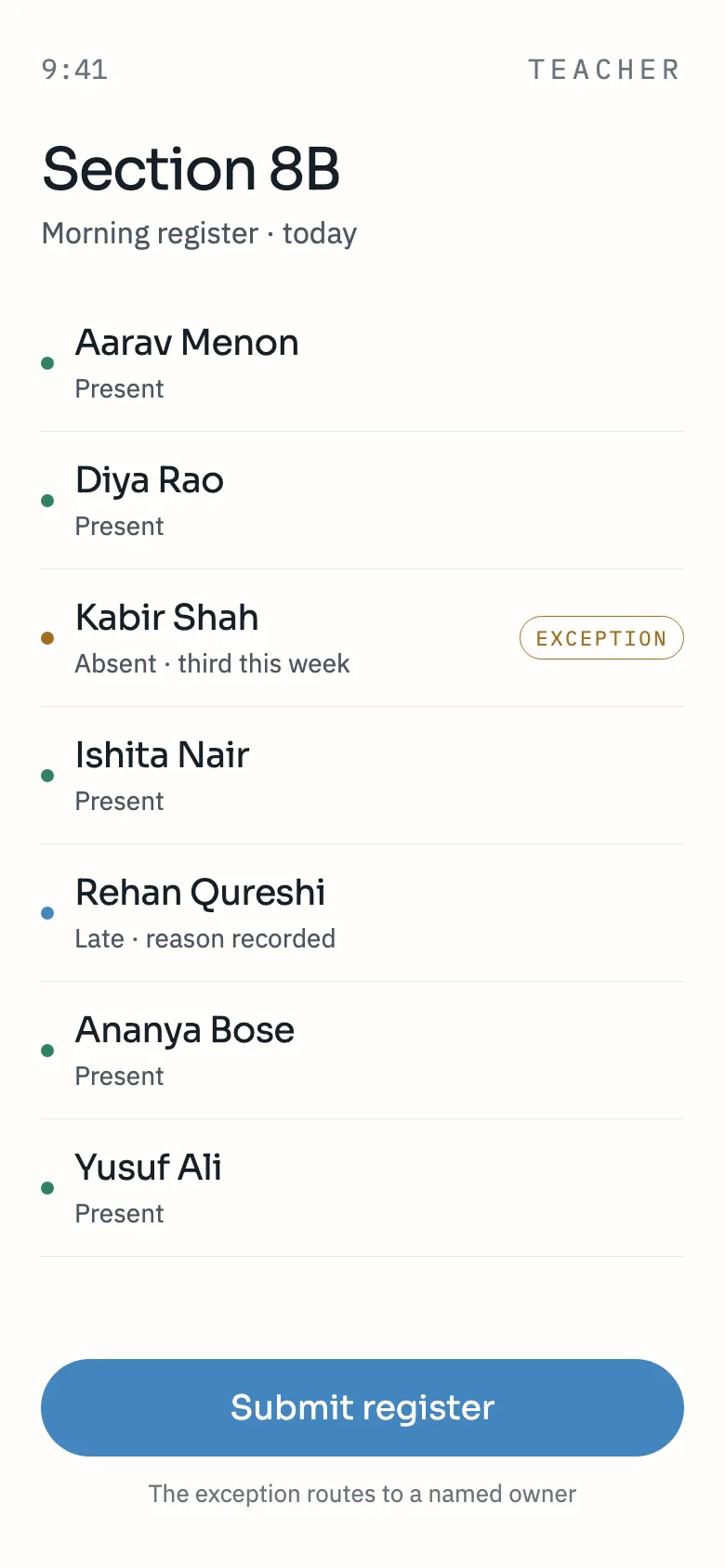
Attendance, lesson delivery, remarks, assessments, communication, and action queues without context switching.

Parent and student app

Fees, receipts, circulars, attendance, academic visibility, and service requests in familiar, multilingual flows.

Leadership visibility

Board reviews, campus-level dashboards, fee risk, academic exceptions, and operational exposure in real time.

Governed intelligence

AEGIS is embedded where context already exists.

SquareCampus remains the primary identity. AEGIS adds governed intelligence on top of the School OS by working with the same timelines, permissions, and records rather than inventing a second system beside them.

Role-aware suggestions
Exception detection from live records
Institution-safe answers inside the same guardrails