
01
System of Record
One institutional truth.
Students, staff, fees, attendance, assessments and documents live on one model, so a question has one answer rather than one answer per tool.
Category and definition
SquareCampus is a School Operating System and institutional decision layer for schools, educational trusts and multi-campus groups in India. It includes the operational systems of record institutions expect, but its primary purpose is to connect recurring school cycles to ownership, exception handling, auditability and leadership decisions.
The distinction that matters
A system of record stores what happened. A decision layer shows what requires attention, why it matters, who owns it, and what happens next.
SquareCampus helps school leadership know what requires attention today, who owns it, and what happens next.
How it is organised
SquareCampus is not described by how many modules it contains. It is described by what each layer changes about the way the institution runs.
01
One institutional truth.
Students, staff, fees, attendance, assessments and documents live on one model, so a question has one answer rather than one answer per tool.
02
Work moves with an owner.
Admissions, collections, results, approvals and parent concerns run as workflows with stages, owners and deadlines — not as tasks held in someone's memory.
03
Every exception is accountable.
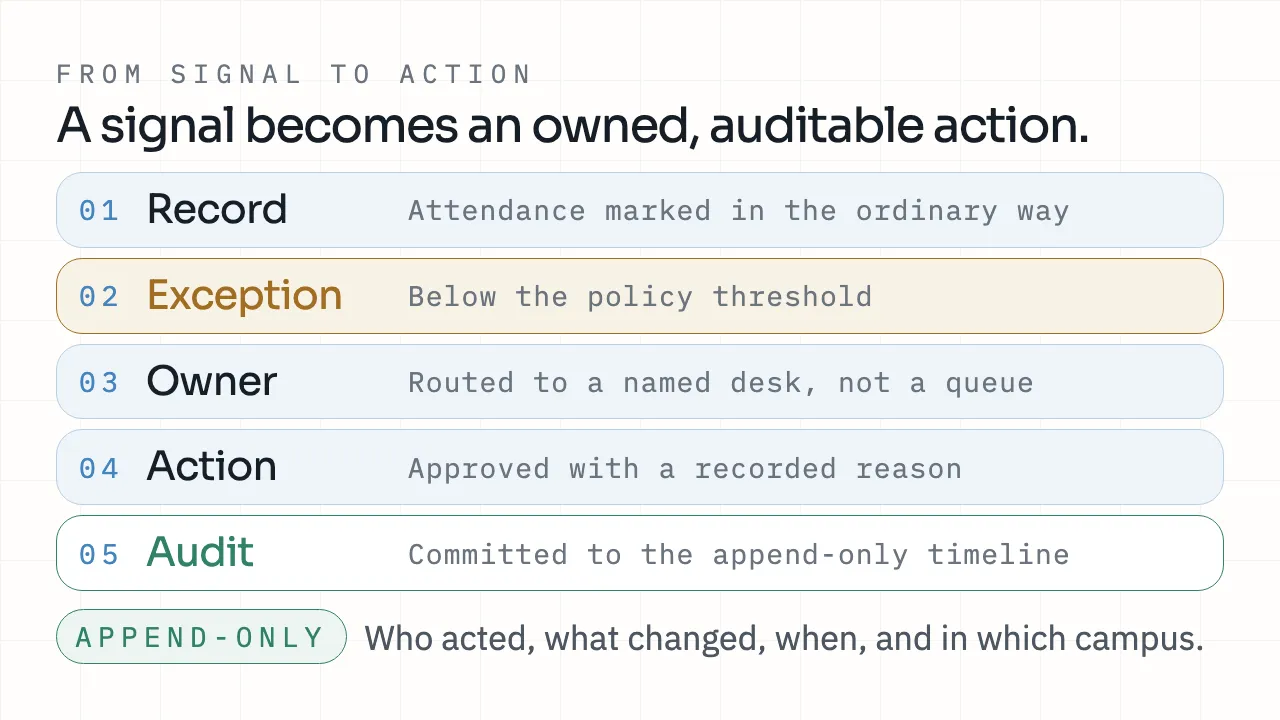
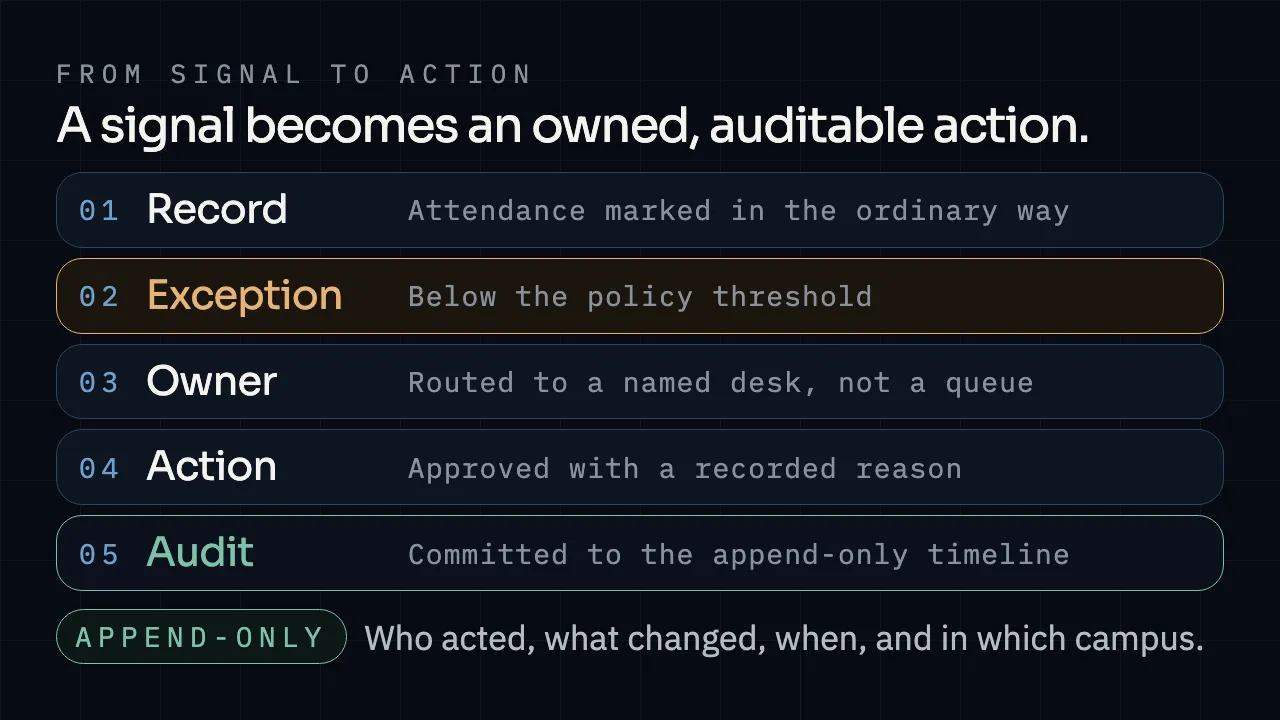
Policy, approval chains, role boundaries and audit history are institutional configuration, so exceptions escalate to a named desk and leave a trail.
04
Leadership sees what requires attention.
AEGIS reads the governed operational context and returns permission-scoped, source-grounded answers about what changed, why it matters and who owns the response.
Dashboard versus decision layer
This is the difference between reporting that describes the institution and an operating layer that moves it.
A dashboard tells you
A decision layer tells you
AEGIS is the governed intelligence layer inside SquareCampus. It produces permission-scoped, source-grounded and auditable operational answers from institutional context.
What the words mean here
These terms are used across the site with specific meanings. This is what each one commits SquareCampus to.
Multi-campus governance versus supporting multiple campuses
| Dimension | Supports multiple campuses | Multi-campus governance |
|---|---|---|
| Structure | Each campus is a separate instance or a branch code on the same records | Trust, school and campus are one hierarchy in the institutional model |
| Policy | Head office circulates a policy; each campus configures its own version | Policy is set once at the trust level and inherited; local variation is recorded as an exception with a reason |
| Access | Campus users are separated by login | Scope is a property of the role: a principal sees one campus, a trust officer sees across campuses, on every screen, report and AEGIS answer |
| Exceptions | Each campus escalates by phone or email | Collections behind plan, attendance drift and stalled approvals surface as owned exceptions, whichever campus they belong to |
| Reporting | Campus reports are consolidated before the board meeting | Board views come from the records the campuses run on, with nothing to reconcile first |
Direct answers
SquareCampus includes the core record and workflow capabilities commonly expected from institutional ERP software. However, it is designed and positioned as a School Operating System: a connected operating backbone where school cycles, ownership, exceptions, governance and leadership visibility share one institutional model.
A School Operating System is the connected operating backbone an institution runs on. It holds the records a school expects, but it also carries the workflows, ownership, approvals, exceptions and audit history that turn those records into accountable day-to-day operations.
A system of record stores what happened. A decision layer shows what requires attention, why it matters, who owns it, and what happens next. SquareCampus is built to do both, so leadership does not have to assemble context before acting.
Indian schools, educational trusts, church-run school groups and multi-campus institutions, and higher-education institutions as a governed layer over the systems they already run. It suits institutions that care about operational control, accountable ownership and leadership visibility — whether they run one campus or many. It is not designed for an institution that needs only basic attendance, fees and report cards at the lowest possible price.
No. AEGIS is the governed intelligence layer inside SquareCampus. It produces permission-scoped, source-grounded and auditable operational answers from institutional context. It is read-only, constrained by the asker's existing role permissions, and does not take autonomous decisions.
Institutions commonly move to SquareCampus from a school ERP, a set of disconnected tools, or a mix of both. Migration scope, sequencing and how long the existing system runs alongside are agreed during discovery rather than assumed.
Governance is policy, approval chains, role boundaries and audit history held as institutional configuration. Exception ownership means a deviation from the expected state becomes a routed item with a named owner, a position and a due date. Accountability means every approval, override and closure is attributed to a person and a role, recorded with the reason, on an append-only timeline.
Supporting multiple campuses means the software can hold several campuses' records. Multi-campus governance means trust, school and campus are one hierarchy: policy is set once and executed locally with deviations recorded as exceptions, access scope is a property of the role, and exceptions and board views cross campuses from the same records without consolidation.
Next step
Bring one cycle that consistently costs your institution time — collections, results, attendance follow-up or parent escalations — and we will map what a governed version of it looks like.