
Transport operations
School Transport in India: What Actually Goes Wrong, and What to Fix First
GPS tracking is the feature every school buys and the smallest part of the problem. Real school transport management is routes planned against live enrolment, fee slabs that follow stop changes, documents that expire quietly, and a way to tell hundreds of anxious parents one true thing at once. Here is where transport actually breaks, and the order in which to fix it.

The tracker gets bought first and fixes the least
Ask a school what it wants from transport software and the first answer is almost always GPS tracking — a live map showing where each bus is. It is the most visible feature, the easiest to demo, and the one parents ask about by name. It is also the easiest part of the problem. Most schools that buy tracking still run the rest of transport on a register, a spreadsheet, and one coordinator’s phone. The map improves; the operation underneath it does not.
Spend a week in a transport office during term and you will see where the real load sits. Routes planned against last year’s enrolment. A fee slab that never heard about a stop change. A driver’s licence that expired inside a file nobody opens. A child who boarded a different bus while a parent waited at the stop. A breakdown managed through one overheating phone. None of these is solved by a dot on a map.
This guide walks through what actually goes wrong in school transport management in India, in the order it tends to hurt, and ends with a short list of what to fix first. It is written to be useful whether or not you ever buy software from us. If you already run a tracking provider you are happy with, keep it — nothing here requires replacing it. The argument is about everything around the map.
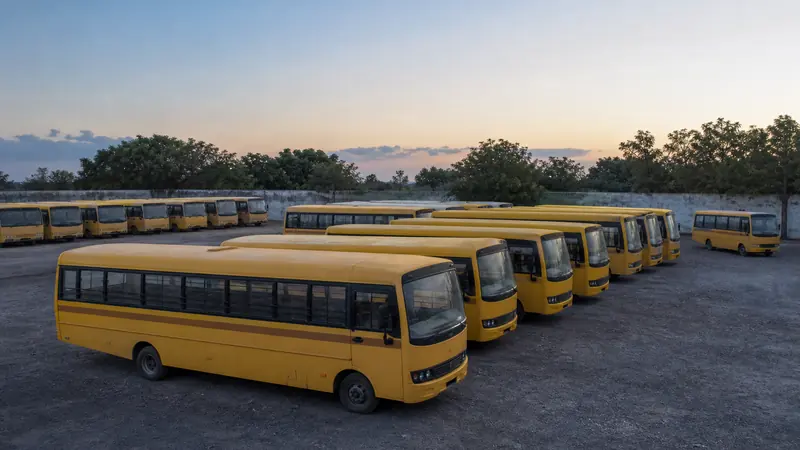
Routes are planned against a school that no longer exists
Most schools plan routes once, before the session starts, against the enrolment they had at planning time. Then the school changes. Admissions continue into the term. Families withdraw, shift house, or move a child from the bus to a private van. By the middle of the first term, the route sheet describes a school that no longer exists — stops nobody uses, stops nobody planned for, and a coordinator adjusting the difference from memory at the depot gate.
Seat allocation is the same problem in a harder form. A route is a promise of a seat, and a bus has a fixed capacity. When allocation lives in a paper register, nobody can say with confidence how many children are assigned to a given bus today — only how many were assigned in June. The gap eventually shows up as an overloaded bus, which is a safety issue, a compliance issue, and a parent-complaint machine in one vehicle.
The first fix is unglamorous: connect the transport roster to live enrolment. When a child is admitted, withdrawn, or changes address, the transport office should hear about it the same day, as a task — not discover it at a stop three weeks later. Route optimisation software has its place, but it optimises whatever roster you feed it. Feed it a stale roster and you get a beautifully optimised description of last year’s school.
The transport fee is a route decision wearing a finance hat
Most Indian schools price transport by slab — a fee band tied to distance or to a named stop, so a child five kilometres out pays less than a child fifteen kilometres out. The slab is what makes the fee fair. It also welds the fee to the route: any change to a child’s stop is a change to what the family owes. That weld is exactly where transport and accounts quietly come apart in most schools.
Mid-term changes are the classic break. A family moves; the coordinator shifts the child two stops down without fuss, because that is good service. But the change never reaches accounts, so the family is billed the old slab for the rest of the year — or the new slab is applied without the arrear or refund ever being worked out. Months later the dispute lands on the principal’s desk, and by then nobody can reconstruct when the stop actually changed, or on whose word.
- One stop change should move, in one motion: the child’s stop and pick-up time on the roster.
- The seat count on both the old bus and the new one, so capacity stays true.
- The fee slab, with the arrear or refund calculated from the date of the change, not the date accounts found out.
- A confirmation to the parent stating the new stop, the new time, and the revised fee.
- A record of who approved the change and when — so the dispute six months later takes minutes, not a meeting.
Drivers, attendants, and the documents that expire quietly
A school bus runs on a stack of dated paper: the driver’s licence, police verification, and medical or eye-test records; the attendant’s records; the vehicle’s fitness certificate, insurance, permit, and pollution certificate. Every one of these carries an expiry date, and every lapsed date is a compliance breach waiting for the day it matters. In most schools these papers live in a personnel file that gets opened exactly twice — when the driver joins, and when something has already gone wrong.
Substitutes are the sharpest version of the problem. The regular driver calls in sick at six in the morning, and someone must decide, within minutes, who drives. If the substitute’s documents were verified at empanelment and have been checked since, that decision is routine. If not, the school has put children on a bus with a driver nobody has formally cleared — not out of negligence, but because the checking process existed only in one person’s memory, and that person is dealing with three other things.
- For each driver and attendant: licence and identity records, police verification, medical and eye-test records — and the date each one lapses.
- For each vehicle: fitness certificate, insurance, permit, and pollution certificate, plus speed-governor and first-aid checks, all with dates.
- For each expiry: a named owner who is warned well before the date, and a recorded closure when the renewal is actually done.
- For substitutes: the same file, maintained before they are ever needed — not assembled on the morning they are.
Boarding and alighting are the attendance that matters most
Classroom attendance is marked everywhere. Bus attendance — who actually boarded which bus, and who got off at which stop — is often marked nowhere. Yet it is the attendance parents care about most, because it answers the only question that matters at half past three: where is my child right now? A tracking map can show where the bus is. It cannot show whether one particular child is on it, and that is the question being asked.
The common incident is mundane, not sinister. A child boards a friend’s bus for a birthday party, or stays back for a practice nobody logged, and a parent stands at a stop watching a bus arrive without their child on it. The next hour is panic, phone calls, and a coordinator reconstructing the afternoon from memory. A recorded boarding and alighting event per child per trip does not guarantee safety — no honest system can promise that. What it does is shorten the distance between the question and a true answer, from an hour of calls to a minute of looking it up.
On breakdown day, the phone tree fails before the bus does
Buses break down, tyres puncture, and traffic does what traffic does. The operational failure is rarely the breakdown itself; it is the next forty minutes. The coordinator’s number is engaged. Class WhatsApp groups fill with second-hand versions of events. Some parents hear the bus is delayed, some hear an accident rumour, and some hear nothing at all and start driving towards the school. One incident becomes hundreds of separate anxieties, each being managed by hand, one call at a time.
What good looks like is boring and specific. The roster already knows exactly which children are on the affected route, so one message reaches exactly those families — not the whole school, and not a WhatsApp group with three years of history. The message comes from the school, names the delay, and commits to a next update. One person owns the incident until the bus is empty, and the closure is recorded. Parents forgive a breakdown. What they do not forgive is silence, contradiction, and finding out from another parent first.

The compliance file a trust must be able to produce on demand
School transport in India carries genuine legal obligations: vehicles must be certified fit, drivers properly licensed and verified, attendants present where required, speed governors and first-aid provisions in place, and the broader safety norms schools are expected to follow honoured in practice. The specifics vary by state and change over time, so this article deliberately cites no rule numbers. Work from the current requirements of your state and your Regional Transport Office, not from a blog post — ours included — or a vendor brochure.
The operational question for a trustee is simpler than the legal one: if an inspector, a board member, or a parent’s lawyer asked tomorrow, could the school produce the file? Not eventually — on demand. In most schools the honest answer is “give us a week”, because the file is spread across a cupboard, a spreadsheet, and a transport contractor’s office. A week is the wrong answer, and everyone in the room knows it. The time to find that out is a quiet Tuesday, not the day it is asked.
- Fitness, insurance, and permit records for every bus — including buses operated by a contractor, which remain the school’s problem in every way that matters.
- Licensing and verification records for every driver and attendant, substitutes included.
- Evidence of speed-governor and first-aid provisions, and of the checks behind them.
- An incident log with closures: what went wrong, who owned it, and how it was resolved.
Almost every transport failure is an exception with no owner
Read back through the failures above and one pattern emerges. The expired licence was visible to anyone who opened the file. The stop change was known to the coordinator who made it. The child on the wrong bus was seen by an attendant. In every case the information existed — what was missing was an owner. Nobody was named, nothing had a deadline, and no record shows whether it was ever resolved. That is not a people problem. It is a structure problem, and it repeats in fees, attendance, and academics exactly as it does in transport.
The alternative is to treat each of these as a routed exception: a named event that lands with a specific position — transport coordinator, accounts officer, campus head — with a deadline and a recorded closure. Position, not person, because coordinators go on leave and staff change; the responsibility has to survive the individual. When a licence nears expiry, that is an exception with an owner. When a stop changes, the fee adjustment is an exception with an owner. The question “did anyone act on this?” stops being a matter of memory and becomes a record anyone can read.
What to fix first — and where SquareCampus fits
If you fix things in the order vendors sell them, you will buy a tracking map first and feel finished. Fix them in the order they hurt instead. Every step below can begin with the tools and the tracking provider you already have, because each one is a question of ownership and record-keeping before it is a question of software. The software’s job, when it comes, is to make the discipline survive staff changes, substitute drivers, and the busiest week of the term.
SquareCampus approaches transport this way because it is built as a School Operating System — a governed operating layer where the roster, seat allocation, fee slabs, document expiries, boarding records, and parent communication live in one place, with named owners and an auditable trail. It does not provide GPS hardware or vehicle telematics; if your school already runs a tracking provider, it stays in place and stays authoritative for location, alongside your existing ERP and payment tools. How a bounded deployment coexists with those systems is described on the ecosystem page at squarecampus.com/ecosystem/, and the wider operating model on the platform page at squarecampus.com/platform/.
A transport-first start is also a fair way to test any system, ours or anyone’s. Transport is bounded, high-pain, and has clear owners, which makes it a good place to see whether a product actually routes exceptions or merely stores records. The staged approach — start bounded, prove it, then consolidate further tools only if the school chooses to — is laid out on the rollout page at squarecampus.com/rollout/. And if you never buy anything at all, run the five fixes below anyway. They cost discipline, not licences, and they sit exactly where transport actually goes wrong.
- First: one live transport roster tied to enrolment, so every admission, withdrawal, and address change reaches transport the same day.
- Second: a document-expiry register for every driver, attendant, and vehicle — each date with a named owner and an early warning.
- Third: boarding and alighting records per child per trip, so “where is my child” has an answer grounded in a record, not a memory.
- Fourth: the fee slab linked to the stop, so a route change adjusts the fee — arrear or refund included — in the same motion.
- Fifth: one communication path for delays and incidents, addressed from the roster to exactly the affected families, with a named owner until closure.
See transport as a governed workflow
Bring your routes, your fee slabs, and the tracking provider you already run. We will walk through how rosters, expiries, boarding records, and parent communication work as one governed workflow — with your existing tools staying in place.