
Exam operations
Exam and Result Operations: Ending the Last-Week Panic
The six weeks from datesheet to report card follow the same script in every Indian school, whatever the board — and so does the last-week panic. This is a walk through the whole cycle, handover by handover: where it breaks, why marks entry is the step that fails most often, and what changes when outstanding work is visible, owned, and dated.

The panic is predictable, which means it is preventable
Picture the week before report cards go out. The coordinator has a printout of which classes are ready, and it is wrong by lunchtime. Two subjects are still missing for one section. The teacher who owns one of them is on leave. The other insists she submitted her sheet on Tuesday. The principal wants a date. The printer wants files. Parents have already been told the date once. Everyone in the staffroom is working late, and nobody can say, precisely, what is actually left to do.
This post is about the six weeks that produce that week — from the day the datesheet is drafted to the day the last corrected report card goes home. The operational grind is the same in every school, whatever the board. And almost every step in it is a handover: a point where work passes from one person to another. Papers pass from setter to office. Scripts pass from invigilator to evaluator. Marks pass from teacher to coordinator. The panic does not come from the work. It comes from handovers that have no named owner and no deadline anyone can see.
One thing before we begin: teachers are not the villains of this story. A class teacher in exam season is setting papers, invigilating, evaluating scripts at home, and entering marks, all on top of a full teaching load. When something is late, it is almost never carelessness. It is a system that gives one person six jobs and gives nobody a view of the whole. Fix the visibility, and the same people, carrying the same workload, stop being the bottleneck.
Build the datesheet against rooms and invigilators, not just dates
A datesheet looks like a calendar exercise. It is actually a capacity exercise. Every exam slot needs rooms with enough desks, and every room needs an invigilator — a teacher assigned to supervise that hall. Those two constraints collide constantly. Three classes sit an exam in the same slot, and the halls hold two of them. A teacher is posted to invigilate at the exact hour her own subject’s paper runs in another block. On paper, the datesheet was fine. On the morning, it is musical chairs.
Seating plans inherit every one of these problems. Most schools still draw them by hand: roll numbers interleaved across sections so neighbours write different papers, chart paper stuck outside each hall. Then a room changes — a hall is needed for an event, or a class turns out larger than the register suggested — and the whole plan is redrawn the night before. None of this is hard work in itself. It is rework, caused by planning the datesheet, the rooms, and the duties in three separate places.
The fix is boring and effective: build the datesheet in the same place that knows room capacity and invigilation duty. Then a clash surfaces the moment it is created, weeks early, when it costs a minute to fix — not on exam morning, when it costs the first half hour of the exam and everyone’s composure. If you check nothing else in a school examination system, check whether it catches these clashes before they happen:
- Two classes scheduled into halls that cannot seat them both, discovered only when the seating plan is drawn.
- A teacher assigned invigilation duty in the same slot as her own subject’s exam.
- Back-to-back papers for the same class with no gap for collecting and counting scripts.
- A late hall change that never reaches the chart on the wall or the invigilator on duty.
Treat question papers as a chain of custody, not a favour
Question paper confidentiality is the most anxious part of exam season and the least written down. A paper is set by one teacher, typed or photocopied by someone else, sealed in an envelope, and locked in an almirah until the morning of the exam. Ask who held it at each point and you will usually get names from memory, not from a record. That is what a chain of custody means — a written trail of who held a thing, at every point, from creation to use.
On the day, the ritual matters. The sealed packet is opened in front of a witness. Papers are counted before distribution, and the count is matched against attendance for that hall. Absentees are recorded there and then, not reconstructed later, because every absentee changes two downstream numbers: how many scripts should come back from that hall, and which students must be recorded as absent — not as zero — in the result. A student who was absent and a student who scored nothing are very different facts.
The written trail is not about suspicion. It is protection. When nothing is recorded and a doubt arises about a paper, the doubt lands on whoever touched it last, with no way to clear themselves. A dated, signed handover record — however simple — protects the people doing the handling. The schools that run this step calmly are not the ones with the most trust. They are the ones with the least ambiguity.
Scripts pass through more hands than anyone counts
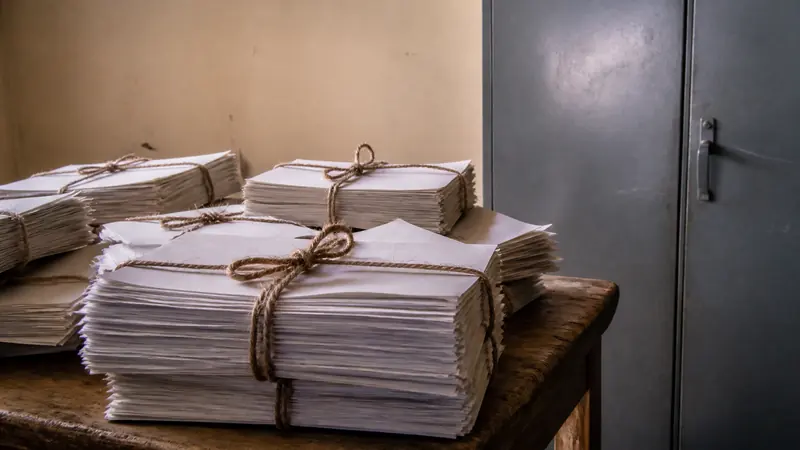
When the bell rings, the invigilator collects the scripts, counts them against attendance, bundles them, and carries the bundle to the exam office or the staffroom. From there, bundles are distributed for evaluation — handed to subject teachers, who often take them home. Count the handovers in that one sentence: student to invigilator, invigilator to office, office to evaluator. Each one is a place where a bundle can sit unclaimed, be miscounted, or quietly go missing for two days while everyone assumes someone else has it.
Every examination in-charge has lived the missing-bundle afternoon. A section’s scripts cannot be found. They are not with the evaluator, who says she returned them. They are not in the almirah. They surface eventually — in a cupboard, under another bundle — but the hours spent searching, and the suspicion that briefly touches everyone, cost more than the scripts did. The cause is never theft. It is a handover that happened without a record.
The remedy is a register discipline most schools already half-follow: every bundle issued to a named evaluator with a date, every bundle returned with a date, and one list showing what is still out and with whom. Whether that list lives in a notebook or in software matters less than whether it exists and is current. Software adds the one thing paper cannot: the coordinator can see, without asking anyone, which bundles have been out the longest.
Marks entry is where the schedule quietly dies
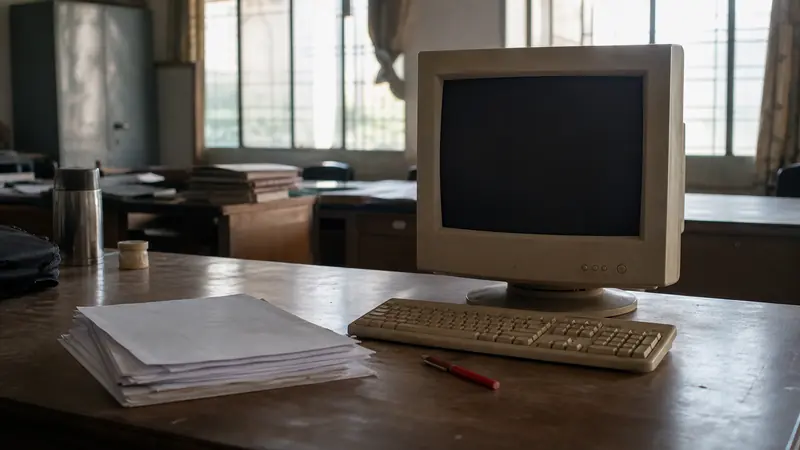
Of every step between datesheet and report card, marks entry fails most often, and it is worth being precise about why. A teacher evaluates scripts at home, in the evenings, and totals marks on a paper sheet. Then those marks must get into the system. That means the shared staffroom computer, which has a queue behind it all through exam season — or logging in from home at eleven at night, reading marks off a paper sheet, tired, for the third section that week. Nothing about this is carelessness. It is a data-entry job stapled onto a teaching job.
Now look at it from the coordinator’s chair. Report cards need every subject for every section. But the coordinator cannot see, in one place, which subject–section combinations have been entered and which are still outstanding. So the chasing begins on WhatsApp — broadcast messages to the whole staffroom, because messaging only the right people would require knowing exactly who is pending. Teachers who finished a week ago get nagged alongside teachers who have not started. The diligent are punished with noise. The pending stay invisible until the day the printer asks for files.
And the entry itself is fragile. Copying marks from a paper sheet into a screen invites transcription errors: the right marks against the wrong roll number, two digits swapped, a row skipped after an interruption. Each error is trivial at the moment of entry and expensive later, because it is usually discovered by a parent holding a printed report card. The step that takes the least judgement in the whole cycle produces the most painful failures.
Turn outstanding marks into an exception queue with named owners
Here is the change that ends most of the chasing. Treat every subject–section combination as a line item with three facts attached: who owns it, when it is due, and how old it is. Anything not complete by its due date becomes an exception — an item flagged precisely because it has missed its expected state — and the list of such items is an exception queue. The coordinator opens one screen and reads it in ten seconds: mathematics for one section pending, owned by a named teacher, three days past due. Everything else is done.
Chasing changes character immediately. Instead of a broadcast to the whole staffroom, it is one conversation with one person about one section — and that conversation often reveals a real obstacle, like a script bundle that arrived late, rather than a lapse. Teachers who are finished are left alone, which is the fairness the staffroom actually notices. The principal reads the same queue and stops calling status meetings. And when the queue is empty, report cards are ready. Not claimed ready — ready.
This is the difference between record-keeping software and a School Operating System: a governed operating layer where work in progress is visible, owned, and dated, not just stored after the fact. The exam workflow described on the platform page at squarecampus.com/platform/ is built around this idea, but the principle is vendor-neutral. Any system that shows you a live, owned, aged list of what is outstanding will end the last-week panic. Any system that cannot will merely record it.
- Every subject–section combination with entered, verified, and pending states — not just a done or not-done flag.
- A named owner for each pending item, so follow-up is one conversation, not a broadcast.
- The age of each pending item, so the oldest gets attention first.
- Absentees carried through from exam day, so an absent student is never silently entered as zero.
- One view shared by the coordinator and the principal, so nobody prepares a status report about the status report.
Moderation and re-evaluation need an audit trail, not a memory
Two review steps follow marks entry, and both change marks after the fact. Moderation is the internal check where a senior teacher reviews marking for consistency — was one evaluator harsher than another — and may adjust marks within school policy. Re-evaluation is a request, usually from a student or parent, to have a script checked again after results are known. Both are healthy. Both are also the moments where the marks in the register, the marks in the software, and the marks on the report card can begin to disagree.
Today, moderation often happens in pencil on the marks sheet, and re-evaluation happens in a hurried conversation after results day. If the original mark is overwritten, there is no record that a change happened at all — which also means no protection for the teacher who made the change in good faith. A term later, when someone asks why a student’s mark differs between two documents, the answer is a reconstruction from memory. Reconstruction from memory, in front of an unhappy parent, is a bad place for any school to stand.
An audit trail fixes this cheaply. An audit trail is a record of who changed what, when, and why — with the original value preserved, never overwritten. A moderated mark shows the raw mark beside it. A re-evaluation shows the request, the reviewer, and the outcome. This is not surveillance of teachers; it is armour for them. One note of scope: for board examinations, the board’s own portal and processes remain authoritative. Everything here concerns the school’s internal examinations, which is where the volume — and the panic — actually live.
One missing subject can hold up an entire class, so plan for it
Consolidation is the step where every subject’s marks for a class are brought together into one result sheet per student. It is also where the slowest subject sets the pace for everyone. A class can have every major subject entered and verified and still print nothing, because one combination is pending. Every coordinator knows this instinctively. The exception queue makes it visible early enough to act on, instead of leaving it to be discovered the night the printer is booked.
When consolidation lives in spreadsheets, the merge itself is a risk: columns misaligned, a sort applied to marks but not to names, a stale copy circulating as final. When it lives in the same system that captured the marks, consolidation stops being a task at all. The result sheet is simply a live view, and report card generation becomes a formality rather than a deadline. The format of the report card matters far less than the integrity of what flows into it.
Then come the corrections that arrive after publication — and they always arrive. A transcription error surfaces when a parent reads the printed card closely. A re-evaluation changes a mark a week after distribution. The test of a mature operation is not whether corrections happen; they always will. The test is whether one correction flows to every place the old number lives. A whitener stroke on one copy is not a correction. It is a brand-new inconsistency, waiting for the transfer-certificate request that will expose it.
- The stored mark, with the old value preserved in the audit trail rather than overwritten.
- The consolidated result sheet, so class-level totals and ranks, where used, stay honest.
- The reprinted report card, clearly versioned, so two different printouts cannot circulate as equals.
- The record of who authorised the correction and why, so next year’s questions have this year’s answers.
What to make a vendor demonstrate live
If you are evaluating exam management software for your school, do not accept a slideshow of report card templates. Ask the vendor to run your workflow, live, with you steering. Nothing below requires buying SquareCampus — any serious school examination system should manage all of it, and a vendor who cannot has told you something valuable for free. One structural note first: a bounded deployment can run exam operations alongside your existing ERP and board portals, which stay authoritative for what they already own. Consolidating other tools later is a choice, not a condition — the rollout page at squarecampus.com/rollout/ describes how that sequencing works.
Run those six live, and the demo will tell you more than any brochure. The pattern behind all of them is the one this whole post has argued: every step from datesheet to report card is a handover, and handovers stay calm only when they have a named owner and a deadline everyone can see. If you would like to watch SquareCampus attempt all six — including the ones we think are genuinely hard — book a walkthrough at squarecampus.com/demo/ and bring your own last exam cycle as the script.
- Build a datesheet with a deliberate clash — two classes into one hall, an invigilator against her own subject — and watch whether the system catches it at creation.
- Enter marks for one subject–section, leave another pending, and ask to see the exception queue: owner, due date, and age, on one screen.
- Mark a student absent on exam day, then open marks entry and confirm the student shows as absent, not as an editable zero.
- Change a mark through moderation and show the original value, the person who changed it, and the reason, preserved side by side.
- Attempt to generate report cards with one subject missing — the system should stop you or flag it loudly, never print blanks silently.
- Make a correction after publication and trace where it propagates: the stored record, the result sheet, the reprint, the audit trail.
See exam operations run without the panic
The platform runs the full cycle on one governed layer — datesheet clashes caught at creation, a live exception queue for marks entry, and an audit trail behind every moderated mark and post-publication correction.